Please note: this article is general information, not medical advice. If you have acute pain, numbness in your legs or pain following an injury, please speak to a doctor or physiotherapist first.
Lower back pain is the most common reason people come to us. It's also one of the biggest health problems in the world: it has been the leading cause of disability globally for at least three decades.2 In up to 90% of people with chronic back pain, doctors can't point to a specific cause such as a fracture or an infection, so the pain is called "non-specific".3 Often it simply comes with hours of sitting, little movement and a stiff, tired body. This is also the kind of back pain that the Pilates research has studied.
What the research says
The largest review of exercise for chronic lower back pain, a Cochrane review of 249 trials, found moderate-certainty evidence that exercise reduces pain compared with no treatment, usual care or placebo. The reduction was about 15 points on a 0–100 scale, which the authors count as a clinically important difference. The effect on everyday function was smaller.2
For Pilates in particular, a Cochrane review of 10 trials (510 people) found low- to moderate-quality evidence that it reduces pain and disability more than minimal intervention. It found no conclusive evidence that Pilates is better than other forms of exercise, and the authors say the choice can come down to personal preference and cost.1
A 2020 network meta-analysis in the British Journal of Sports Medicine compared types of exercise against each other. Pilates ranked highest for pain, with motor control and aerobic exercise close behind. Stretching and McKenzie exercises did not clearly differ from no treatment.3 The authors rate this evidence as low quality, and they add that one type of exercise is unlikely to be the single best approach.
Source: Owen et al., 2020, network meta-analysis; low-quality evidence. The authors treat a 20-point drop as clinically meaningful. Hands-on therapist treatment (e.g. manual therapy) came out at +2. [3]
Clinical guidelines point the same way. The American College of Physicians recommends that people with chronic lower back pain start with non-drug treatments such as exercise, motor control exercise, yoga and tai chi.4 In the UK, NICE suggests considering a group exercise programme (biomechanical, aerobic, mind–body or a mix) chosen around the person's needs, preferences and abilities.5 Pilates fits comfortably within that.
Why it may help: what we focus on in class
Research shows clearly that exercise helps; it is much less clear exactly why. These are the things we work on, based on our teaching experience:
- Strength in the deep muscles around your spine that support you as you sit, lift and walk.
- Freer hips and glutes. Many people with a sore back also feel stiff through the hips.
- Calm breathing. Breathing into your ribs helps you relax your back and engage your abdominals.
- Posture and confidence in movement, so bending and lifting feel less worrying.
The guidelines also stress choosing exercise you like.5 If you enjoy coming to class, you'll keep coming, and that matters more than any single exercise.
Three exercises we do in almost every class
Pelvic tilt. Lie on your back with your knees bent. As you breathe out, gently press your lower back into the floor; as you breathe in, let it return. 10 slow repetitions.
Bridge, vertebra by vertebra. From the same position, slowly lift your pelvis one vertebra at a time, then roll back down the same way. It mobilises the back and wakes up your glutes.
Cat and cow. On all fours, alternate between rounding and gently arching your back in time with your breath. It brings back mobility after a long day at your desk.
Stay within a range that feels comfortable. Mild effort is fine; sharp or shooting pain means stop.
Reformer or Mat if you're in pain?
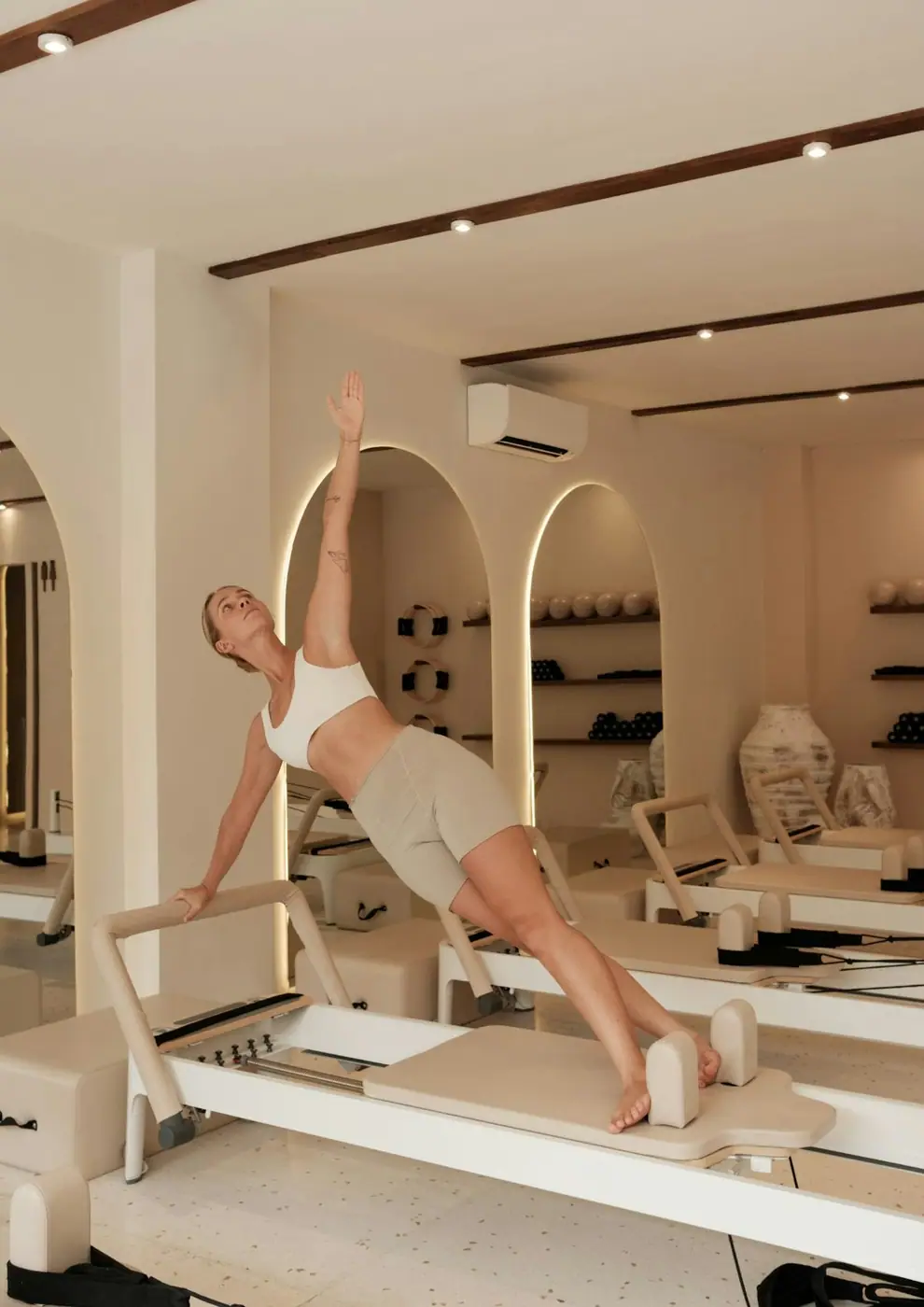
If you have lower back pain, we recommend starting on the Reformer. The springs support your body and let you move your spine with less load. This is our practical advice rather than a research finding: we haven't found trials comparing Reformer and Mat for back pain. The studies above looked at non-specific back pain. If you have sciatica, a herniated disc or a recent injury, check with your doctor or physiotherapist first, and a 1:1 private session is the safest way to start.
When to see a doctor first
For most back pain, the NHS advises staying active rather than resting in bed. Some symptoms, though, need medical attention before you exercise.6
- Stay active and keep up your daily activities as much as you can.
- Try simple back exercises, and heat or cold packs.
- Avoid long periods in bed.
- See a GP if it hasn't improved after a few weeks of self-care, or if you have unexplained weight loss, a lump in your back, or pain that is worse at night or when you cough or sneeze.
- Pain, tingling, weakness or numbness in both legs.
- Numbness around your genitals or bottom, or changes in bladder or bowel control.
- Fever, chills or you feel generally unwell.
- Sudden severe pain, or pain that is getting worse quickly.
- Back pain that started after a serious accident.
The first two in the "help first" list are emergencies: the NHS says to call 999 or go to A&E, and not to drive yourself.6
Your first steps with us
- Check the list above
If none of it applies, you can start. If something does, see a doctor first.
- Tell your instructor about your back
When it hurts, which movements set it off and whether you have a diagnosis. We'll skip exercises that aren't right for you and give you an alternative.
- Start with support
A Reformer class or a 1:1 session, with a smaller range of movement at first.
- Give it a few weeks
The programmes in the studies lasted at least four weeks.3 Come regularly and build up gradually. Pain is not part of the workout: if something hurts, we stop.
Sources
- Yamato TP, Maher CG, Saragiotto BT, et al. (2015). Pilates for low back pain. Cochrane Database of Systematic Reviews, (7), CD010265. doi:10.1002/14651858.CD010265.pub2
- Hayden JA, Ellis J, Ogilvie R, et al. (2021). Exercise therapy for chronic low back pain. Cochrane Database of Systematic Reviews, 9, CD009790. doi:10.1002/14651858.CD009790.pub2
- Owen PJ, Miller CT, Mundell NL, et al. (2020). Which specific modes of exercise training are most effective for treating low back pain? Network meta-analysis. British Journal of Sports Medicine, 54(21), 1279–1287. doi:10.1136/bjsports-2019-100886
- Qaseem A, Wilt TJ, McLean RM, et al. (2017). Noninvasive treatments for acute, subacute, and chronic low back pain: a clinical practice guideline from the American College of Physicians. Annals of Internal Medicine, 166(7), 514–530. doi:10.7326/M16-2367
- National Institute for Health and Care Excellence (2016, updated 2026). Low back pain and sciatica in over 16s: assessment and management (NG59). nice.org.uk/guidance/ng59
- NHS (2026). Back pain. NHS.uk, page last reviewed 5 March 2026. nhs.uk/conditions/back-pain
Sources last checked: 20 October 2026