It's the first question we hear from almost every new client. The short answer: both are Pilates and both work on the same principles. The difference lies in the equipment and in how it feels. And here's something few people know: the two have been compared head to head in several studies, so we don't have to guess.
What is Mat Pilates?
Mat is classical Pilates on a mat. Your own body provides the resistance, and sometimes we add a ball, a band or a ring. Because there's no machine to support you, your core (abdominals, back and pelvic floor) is working the whole time.
- It teaches you to control your body without assistance.
- A great foundation for breathing and posture.
- It's easy to keep practising at home, because all you need is a mat.
What is the Reformer?
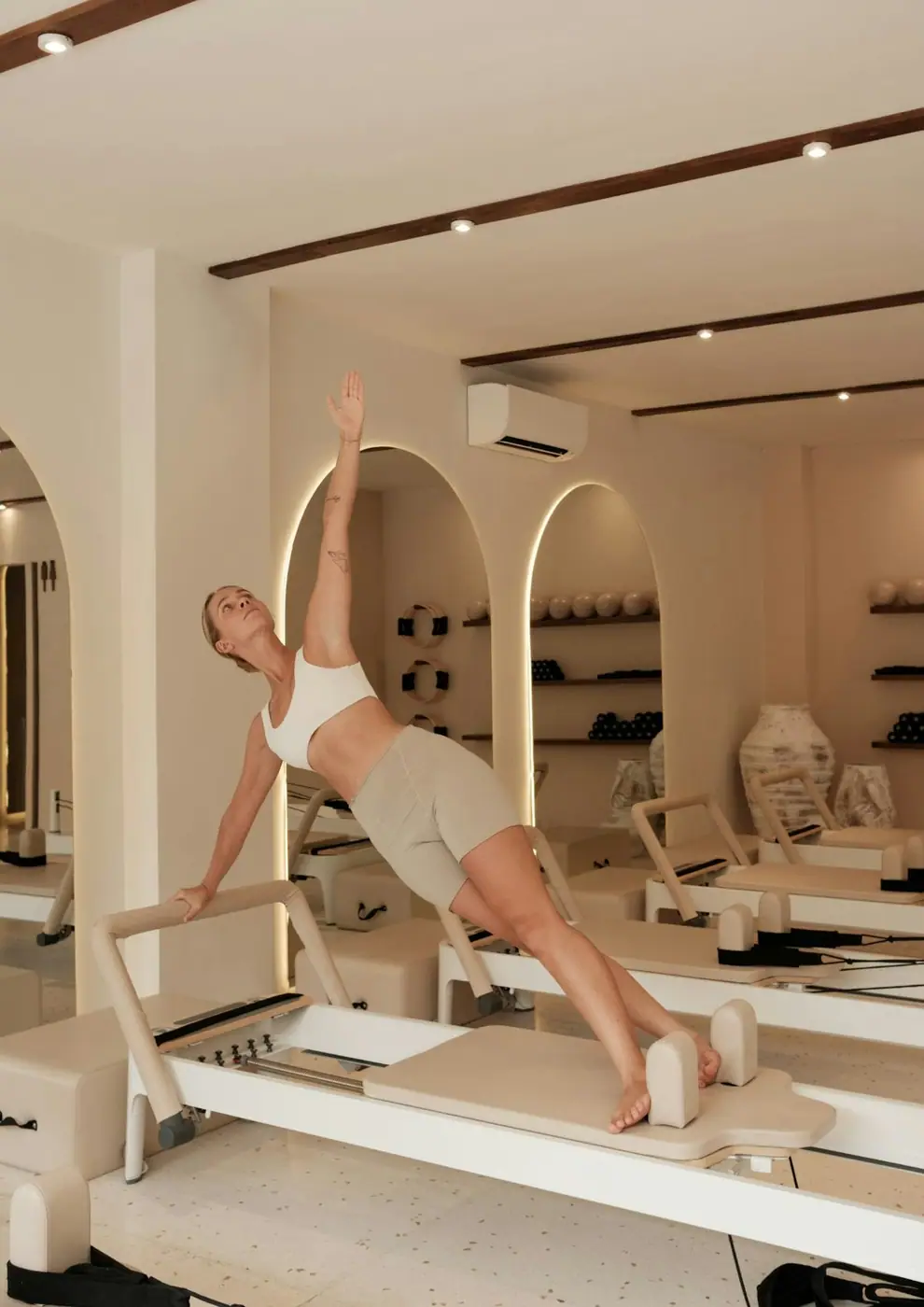
The Reformer is a bed-like frame with a sliding carriage, springs and straps. The springs both support you and create resistance. That means you can do an exercise you still find hard on the mat, or make it more challenging as you grow stronger.
- The springs let us set the load precisely: lighter at the start or after a break, heavier as you progress.
- The carriage reacts the moment you lose control, which helps you feel the right movement. The authors of one comparison study think this feedback is exactly why people progressed faster on the equipment.2
- A huge range of exercises, so it never gets boring.
| Mat | Reformer | |
|---|---|---|
| Resistance | Your own body, a band, ball or ring | Springs of different weights, set for each exercise |
| Support | None, your body holds itself | Springs and carriage help with the hard movements |
| Feedback | You learn to feel your position yourself | The moving carriage instantly "shows" when you lose control2 |
| Low back pain (studies) | Improvement in pain and function12 | Improvement, sometimes faster or longer-lasting for function12 |
| At home | Yes, you only need a mat | No, it needs the machine, so you train in the studio |
| Class price | Usually more affordable | Usually higher |
Sources: [1], [2]. Price and format are general observations, not study data.
What the research says
The best-studied comparison is in chronic low back pain. In a Brazilian trial, 86 people with this kind of pain did 12 sessions over 6 weeks, either on the mat or on equipment. Both groups improved. At 6 months the equipment group had less difficulty with daily activities and less fear of movement, but pain was the same in both groups.1 In a Spanish trial with 98 people and 12 weeks of training, both Pilates groups improved on every outcome measured, and the equipment group improved faster.2
A small 2026 study compared the two in 45 women with painful periods, twice a week for 12 weeks. Both helped, and Reformer led to a bigger drop in pain and better sleep. There was no difference for mood or fatigue.3 Each group had only 15 women, so treat this as a good sign rather than a final answer.
The wider picture matters too. A Cochrane review found that Pilates helps low back pain more than minimal treatment, but the evidence is of low to moderate certainty. It also hasn't been shown to beat other types of exercise.4 A large network meta-analysis of 118 trials in chronic low back pain ranked Pilates first among exercise types for pain and function. That's a ranking, not a guaranteed effect.5 Our takeaway is simple: training regularly is what matters, and the type you enjoy and keep coming back to is the right one.
Standardised mean difference (SMD), 9 randomised trials, 415 people over 60. Values above 0.8 are considered a large effect. Some trials were of lower quality, so the evidence is limited. Source: [6]
In other words, the mat is not the "little sister". In older adults, Mat alone, with no machines at all, improves balance, strength and endurance.6
Masha's tip: if you've never trained before, start with Reformer Foundations. We explain the machine step by step, and the springs will help you feel the right movement from the very first time. If you have back or knee pain or another injury, check with your doctor or physiotherapist first and tell us before class so we can adapt the exercises.
Which should I choose?
- you want a load that grows with you;
- you like support and clear feedback on the hard movements;
- you're coming back after a break and want to start lighter;
- you simply love the energy of the machine.
- you want to build a foundation: breath, posture, control;
- you want to keep practising at home;
- you're looking for a more affordable option;
- you love calm classes with plenty of attention on the breath.
In our experience the best option is a combination: one Mat and one or two Reformer classes a week. Mat teaches control; Reformer puts it to work.
How often?
Twice a week is a good target. The comparison studies above used 2 sessions a week13, and the low back pain meta-analysis recommends at least 1 to 2 sessions a week.5 In the studio we see many clients feel the first changes in their posture after 8 to 10 classes. That's our observation, not a promise: every body is different.
On its own, Pilates is light-to-moderate activity: on average around 3 to 3.7 METs, and the certainty of that estimate is low.7 So it doesn't fully replace the movement the World Health Organization recommends: 150 to 300 minutes of moderate activity a week plus muscle-strengthening on at least 2 days.8 Pilates covers the strength; walking adds the minutes.
Three classes cover the advice to strengthen muscles on at least 2 days a week, and the walks help you reach 150 minutes of moderate activity. Sources: [7], [8]
If you can only fit in two classes right now, start with one Reformer and one Mat. Add more once you're used to it.
Sources
- da Luz MA, Costa LO, Fuhro FF, et al. (2014). Effectiveness of mat Pilates or equipment-based Pilates exercises in patients with chronic nonspecific low back pain: a randomized controlled trial. Physical Therapy, 94(5), 623–631. doi:10.2522/ptj.20130277
- Cruz-Díaz D, Bergamin M, Gobbo S, et al. (2017). Comparative effects of 12 weeks of equipment based and mat Pilates in patients with Chronic Low Back Pain on pain, function and transversus abdominis activation. A randomized controlled trial. Complementary Therapies in Medicine, 33, 72–77. doi:10.1016/j.ctim.2017.06.004
- Şevgin Ö, Postacı S, Dikmen Hoşbaş B (2026). Comparison of two different Pilates exercise methods in women with dysmenorrhea: a randomized controlled trial. Scientific Reports, 16, 22123. doi:10.1038/s41598-026-52762-7
- Yamato TP, Maher CG, Saragiotto BT, et al. (2015). Pilates for low back pain. Cochrane Database of Systematic Reviews, (7), CD010265. doi:10.1002/14651858.CD010265.pub2
- Fernández-Rodríguez R, Álvarez-Bueno C, Cavero-Redondo I, et al. (2022). Best Exercise Options for Reducing Pain and Disability in Adults With Chronic Low Back Pain: Pilates, Strength, Core-Based, and Mind-Body. A Network Meta-analysis. Journal of Orthopaedic & Sports Physical Therapy, 52(8), 505–521. doi:10.2519/jospt.2022.10671
- Bueno de Souza RO, Marcon LF, Arruda ASF, et al. (2018). Effects of Mat Pilates on Physical Functional Performance of Older Adults: A Meta-analysis of Randomized Controlled Trials. American Journal of Physical Medicine & Rehabilitation, 97(6), 414–425. doi:10.1097/PHM.0000000000000883
- Vitor GBB, de Oliveira LC, Pessôa RAG, et al. (2026). Metabolic intensity and energy cost of Pilates exercises: an exploratory systematic review and meta-analysis of limited and heterogeneous evidence. Systematic Reviews, 15, 42. doi:10.1186/s13643-025-03056-y
- Bull FC, Al-Ansari SS, Biddle S, et al. (2020). World Health Organization 2020 guidelines on physical activity and sedentary behaviour. British Journal of Sports Medicine, 54(24), 1451–1462. doi:10.1136/bjsports-2020-102955
Sources last checked: 20 October 2026