A first class always feels a little nerve-racking. A new studio, an unfamiliar machine, people who all seem to know what they're doing. Here's exactly what will happen, so you can arrive feeling at ease.
How your first visit unfolds
So you know what's coming before you even walk through the door, here's the whole journey from booking to heading home.
- You book online
Pick a day and time from the timetable and tick “First visit”. That way your instructor knows you're new and plans a little extra time for you.
- You arrive 10 minutes early
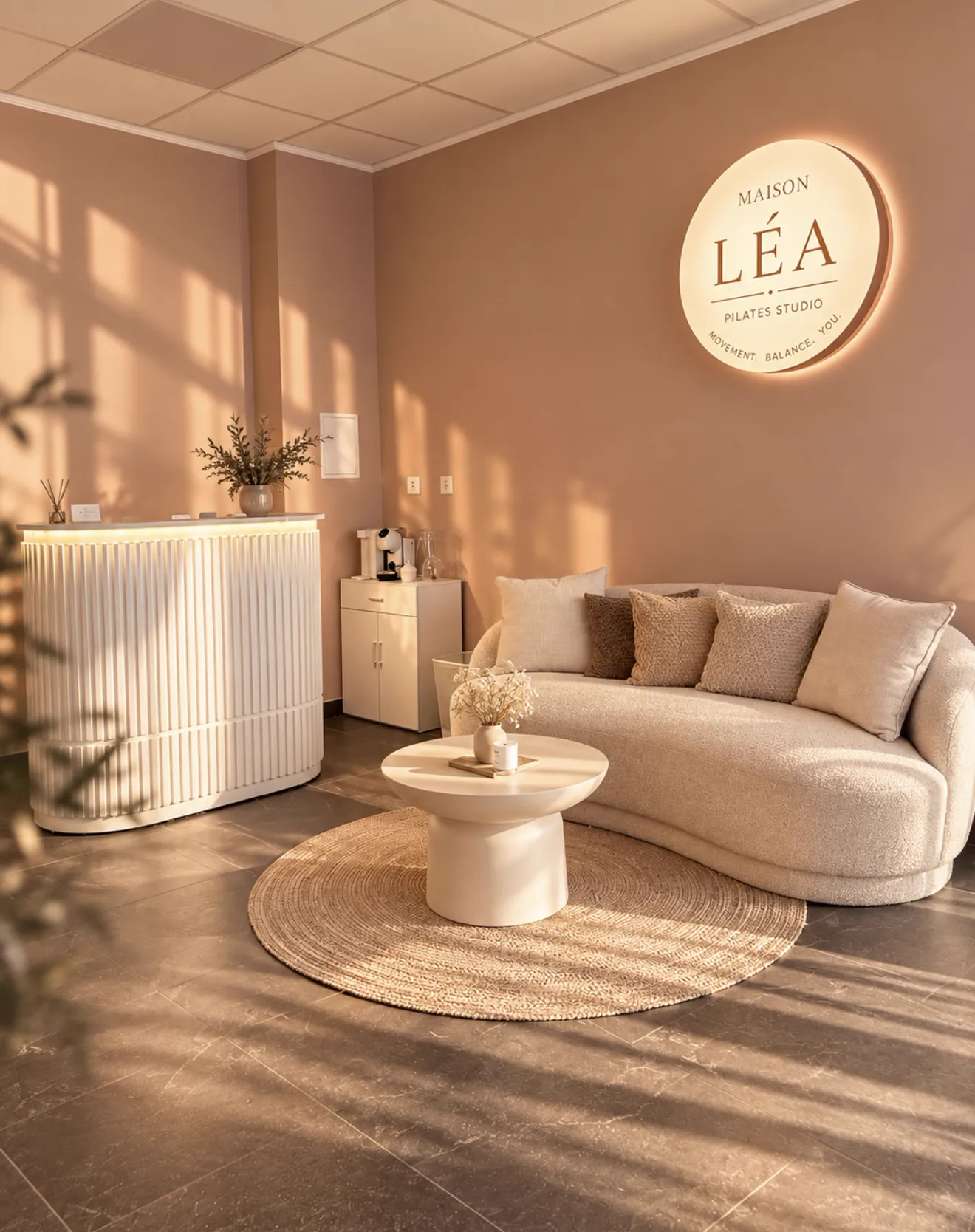
We welcome you and show you where to leave your things and where to change. No need to rush.
- A quick chat
We ask about injuries, surgery, pregnancy and what you'd like to achieve. This isn't a formality: it's how your instructor knows what to adapt for you.
- Reformer set-up
We show you how to change the springs and adjust the headrest and straps. It takes about two minutes.
- The class
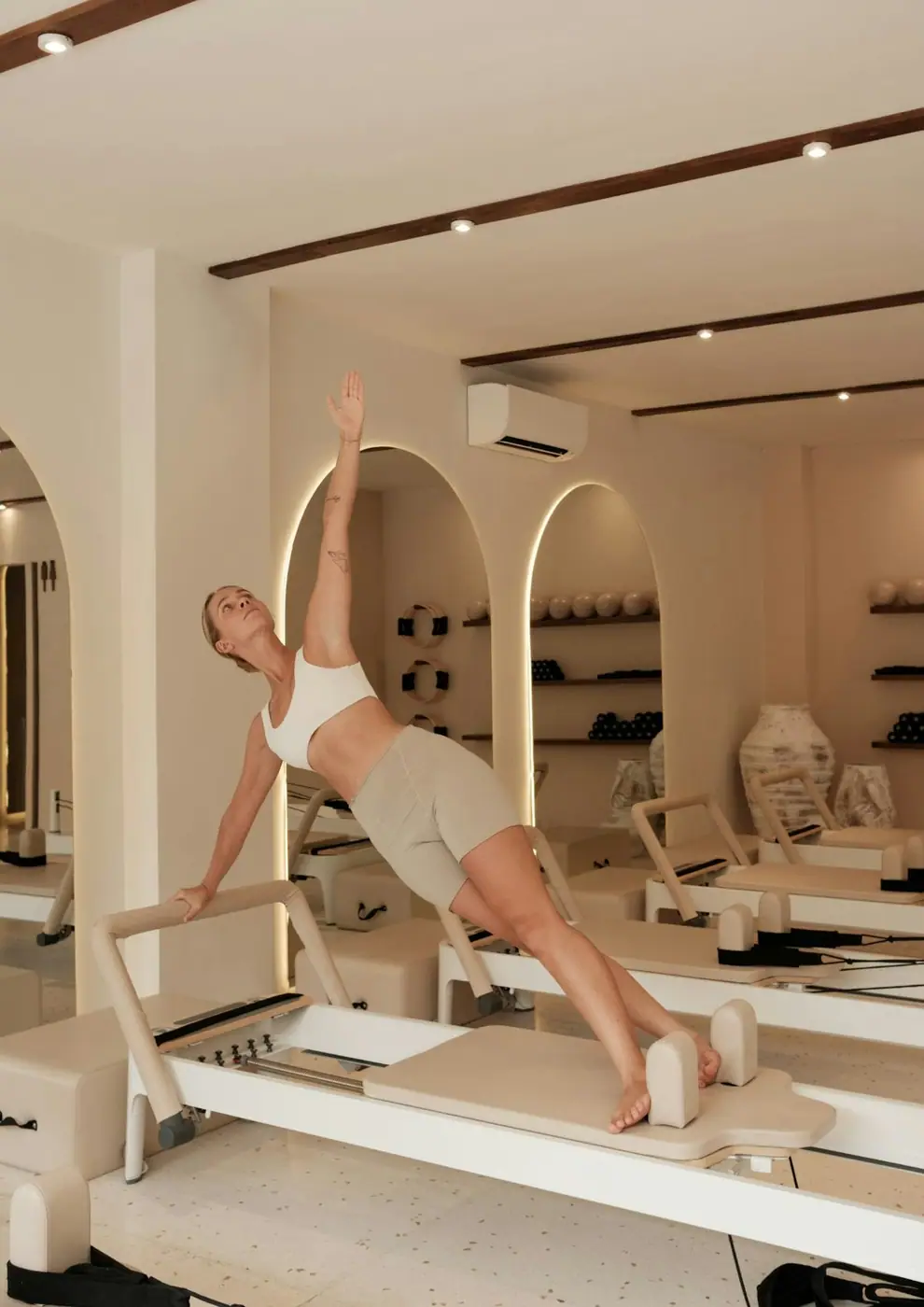
You work in a small group (up to 3 on the Reformer), with lots of cues on breathing, position and pace.
- After class
Have some water, stretch gently and, if you like, talk to your instructor about next steps.
What to bring and what to leave at home
Wear something comfortable and close-fitting that you can bend in. Loose T-shirts ride up during exercises on your back, and wide trouser legs can catch in the straps. Grip socks are a must on the Reformer: they stop you slipping on the platform. If you don't have any, you'll find them at reception.
- Close-fitting leggings or shorts and a T-shirt/top
- Grip socks (or pick some up at reception)
- A bottle of water
- A hair tie or clip for long hair
- Details of any injuries, surgery or pregnancy to share with us
- A heavy meal shortly before class
- Baggy clothes and anything with zips or buttons on the back
- Jewellery that jangles or catches
- Shoes on the platform (we train in socks)
- The idea that you have to “get it right” first time
Food and water before class
In our experience, it's more comfortable not to eat a heavy meal for at least an hour before class. Pilates has lots of abdominal work, twists and forward bends, and a full stomach gets in the way. A light snack earlier on is perfectly fine. If you follow a specific regimen (for example with diabetes), follow your doctor's advice.
As for water: the American College of Sports Medicine (ACSM) advises starting exercise well hydrated and, when needed, drinking extra alongside your usual meals and fluids at least several hours beforehand, so your body has time to absorb it.2 The same statement stresses that people sweat very differently, so there's no single amount that suits everyone.2 In practice: drink normally through the day, bring a bottle and sip when you're thirsty.
During the class
Pilates is a mind-body form of exercise that focuses on strength, core stability, flexibility, muscle control, posture and breathing. It can be done on a mat or on specialised equipment such as the Reformer.1 That's why you'll hear a lot about breathing and your “centre”. The method's traditional principles are centring, concentration, control, precision, flow and breathing.1 You don't need to memorise them; your instructor will show you them in motion.
Reformer groups are capped at 3, so Masha sees every movement and corrects it straight away. Don't worry if at first you can't coordinate breathing, position and pace all at once. Nobody manages it first time round. If something hurts (sharp pain, not just effort), say so right away: almost every exercise has an easier version.
The secret: slower is harder, and more effective. If you're tempted to speed up, slow down.
After the class: soreness and recovery
You'll probably feel muscles you never knew you had. Delayed onset muscle soreness (DOMS) is most common when your body meets a new type of movement or returns to training after a break.3 It's triggered especially by eccentric work, where the muscle works while it lengthens.3 On the Reformer, many of the controlled returns against the spring are exactly that.
The popular “lactic acid” explanation is only one of several hypotheses. According to the review by Cheung and colleagues, soreness is most likely explained by a combination of mechanisms, and the exact causes are still not fully understood.3
What helps? According to the same review, gentle exercise is the most effective way to ease the pain, although the effect is temporary.3 So go for a walk the next day rather than lying on the sofa. Stretching and cold have shown no effect on the soreness itself.3 They may feel nice, but don't expect miracles. If the pain is sharp, in a single joint or doesn't ease after a few days, see a doctor.
How often after your first class?
Your second class is usually much easier, because you already know the machine and the terminology. The World Health Organization recommends muscle-strengthening activity on at least two days a week, alongside 150–300 minutes of moderate aerobic activity (such as brisk walking).4 Pilates covers the strength part; walking and cycling cover the aerobic part. If you're far from those numbers right now, don't worry: according to the WHO, some activity is better than none, and it's best to build up frequency and intensity gradually.4
One or two classes a week is a good start for the first few weeks. If you enjoyed it, see our first steps and prices and passes.
Sources
- Wells C, Kolt GS, Bialocerkowski A (2012). Defining Pilates exercise: a systematic review. Complementary Therapies in Medicine, 20(4), 253–262. doi:10.1016/j.ctim.2012.02.005
- American College of Sports Medicine; Sawka MN, Burke LM, et al. (2007). American College of Sports Medicine position stand. Exercise and fluid replacement. Medicine & Science in Sports & Exercise, 39(2), 377–390. doi:10.1249/mss.0b013e31802ca597
- Cheung K, Hume P, Maxwell L (2003). Delayed onset muscle soreness: treatment strategies and performance factors. Sports Medicine, 33(2), 145–164. doi:10.2165/00007256-200333020-00005
- Bull FC, Al-Ansari SS, Biddle S, et al. (2020). World Health Organization 2020 guidelines on physical activity and sedentary behaviour. British Journal of Sports Medicine, 54(24), 1451–1462. doi:10.1136/bjsports-2020-102955
Sources last checked: 20 October 2026